Launch offer — valid today only

📄 Digital book in PDF · read it on your phone or print it

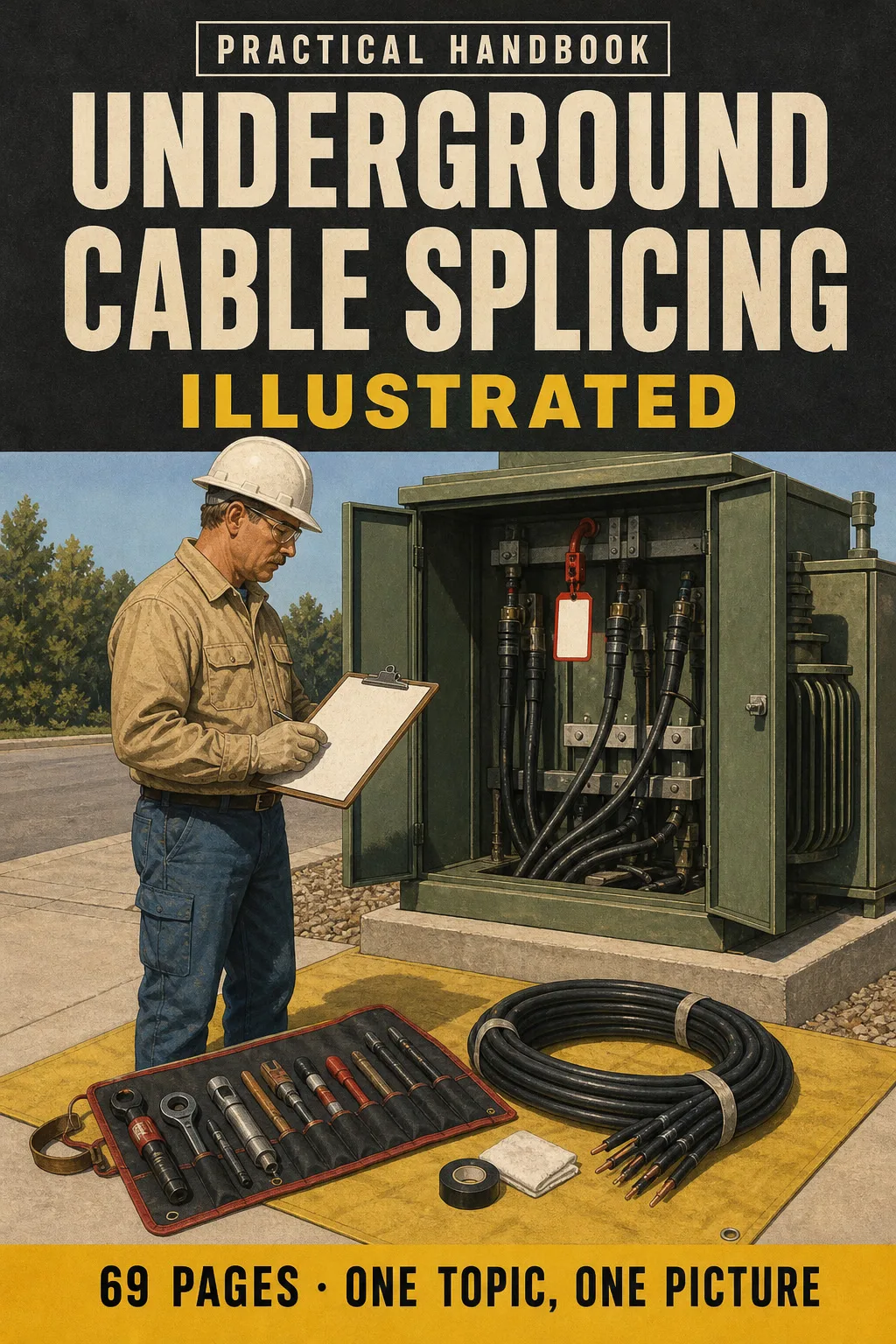
Underground Cable Splicing Illustrated: Every Cut, Splice and Elbow in Drawings Every Step in the Same Order

Cable layers, approach distances, the 5-step cut-back, crimping, cold-shrink and heat-shrink splices, elbows, padmounts and VLF testing. Every topic has its own page: the drawing first, then what you need to remember. 69 illustrated pages.

I WANT EVERY SPLICE DRAWN

🔒 Secure checkout · PDF by email · 30-day guarantee

Every topic, its own pageEach cut-back, splice and termination drawn, with the explanation beside it
69 illustrated pages9 parts, from the cable layer by layer to the field checklists
Up-to-date sourcesOSHA 1910.269, the NESC and IEEE 48, 386 and 404
PDF by emailFormat

Look Inside the Book

Each page has one big drawing and a box with the dimensions, steps and checks you need to know:

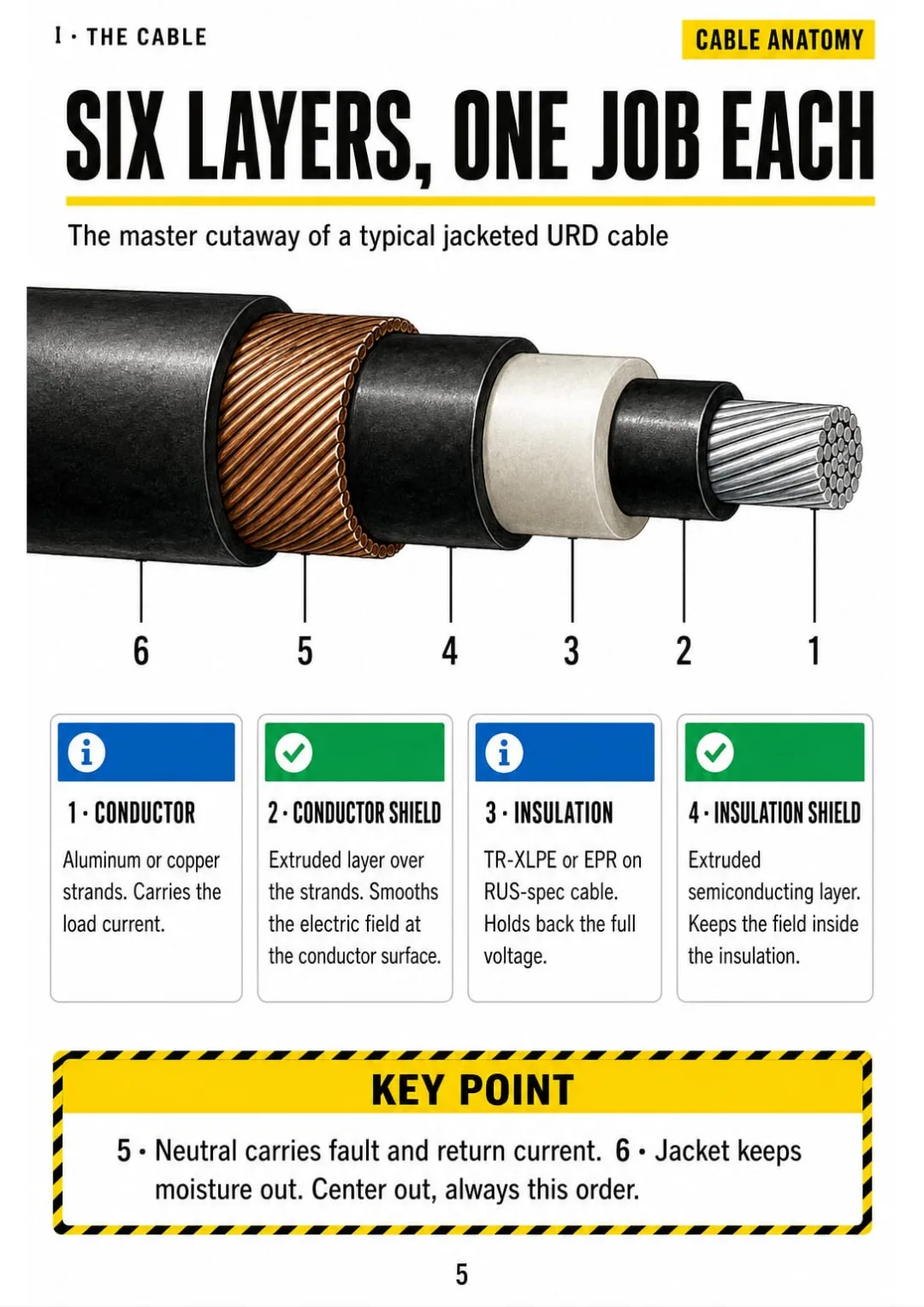
Conductor, conductor shield, insulation, insulation shield, neutral, jacket: one cutaway, six jobs.
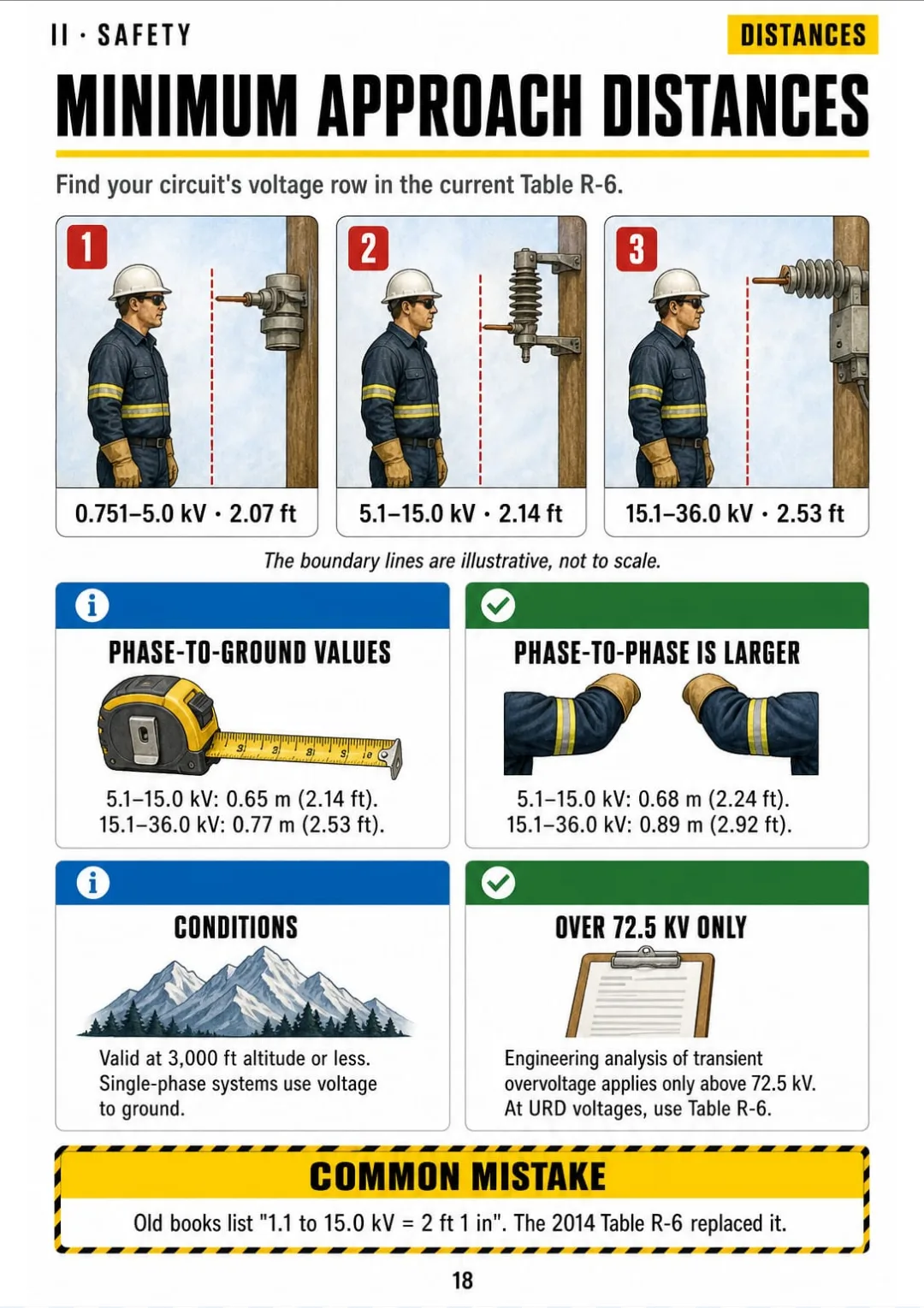
Table R-6, 5.1–15.0 kV: 0.65 m (2.14 ft) phase-to-ground.
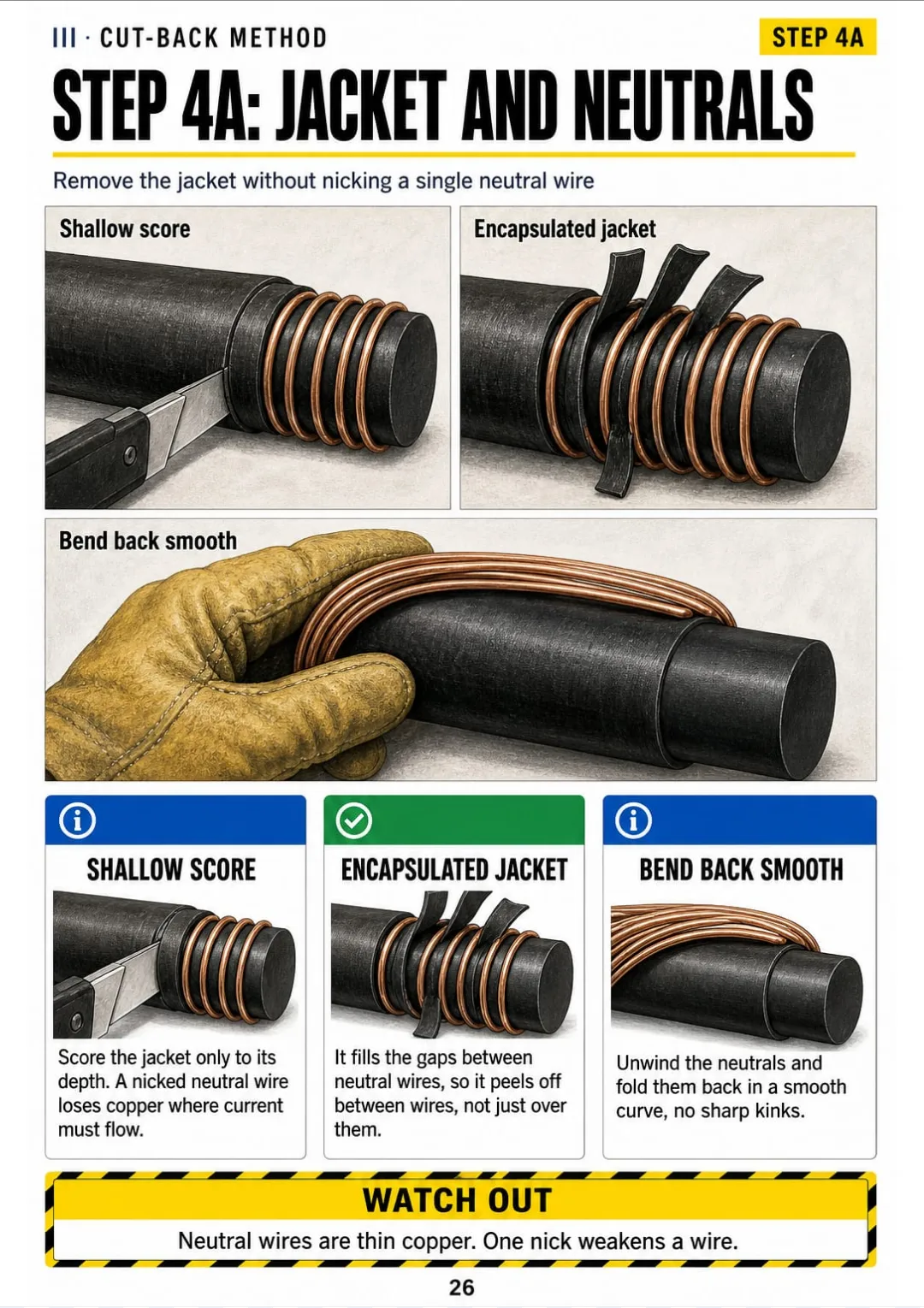
Overall vs encapsulated jacket: cut the jacket, never the neutral wires.
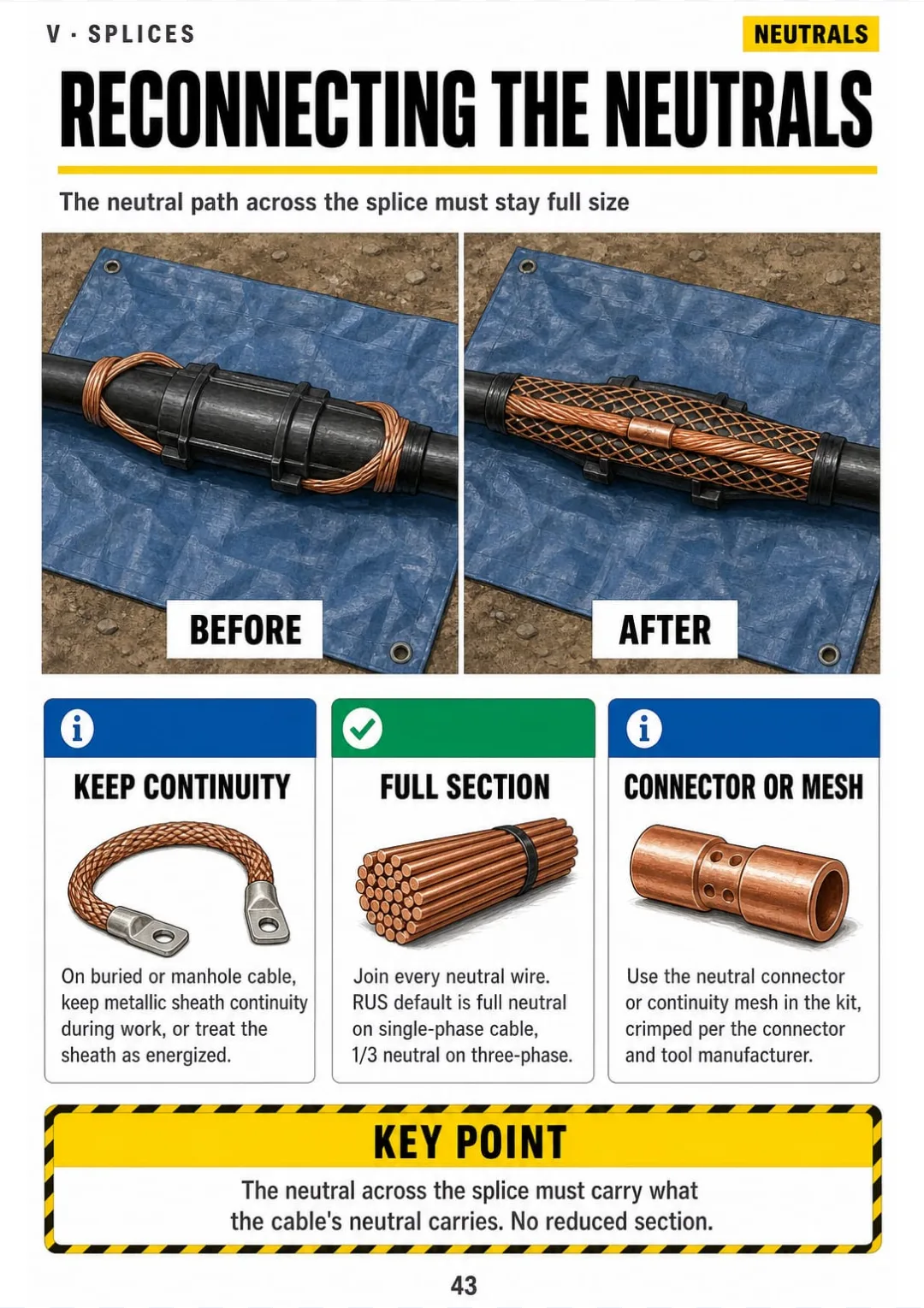
Before and after: concentric neutral wires rejoined across the splice at full section.
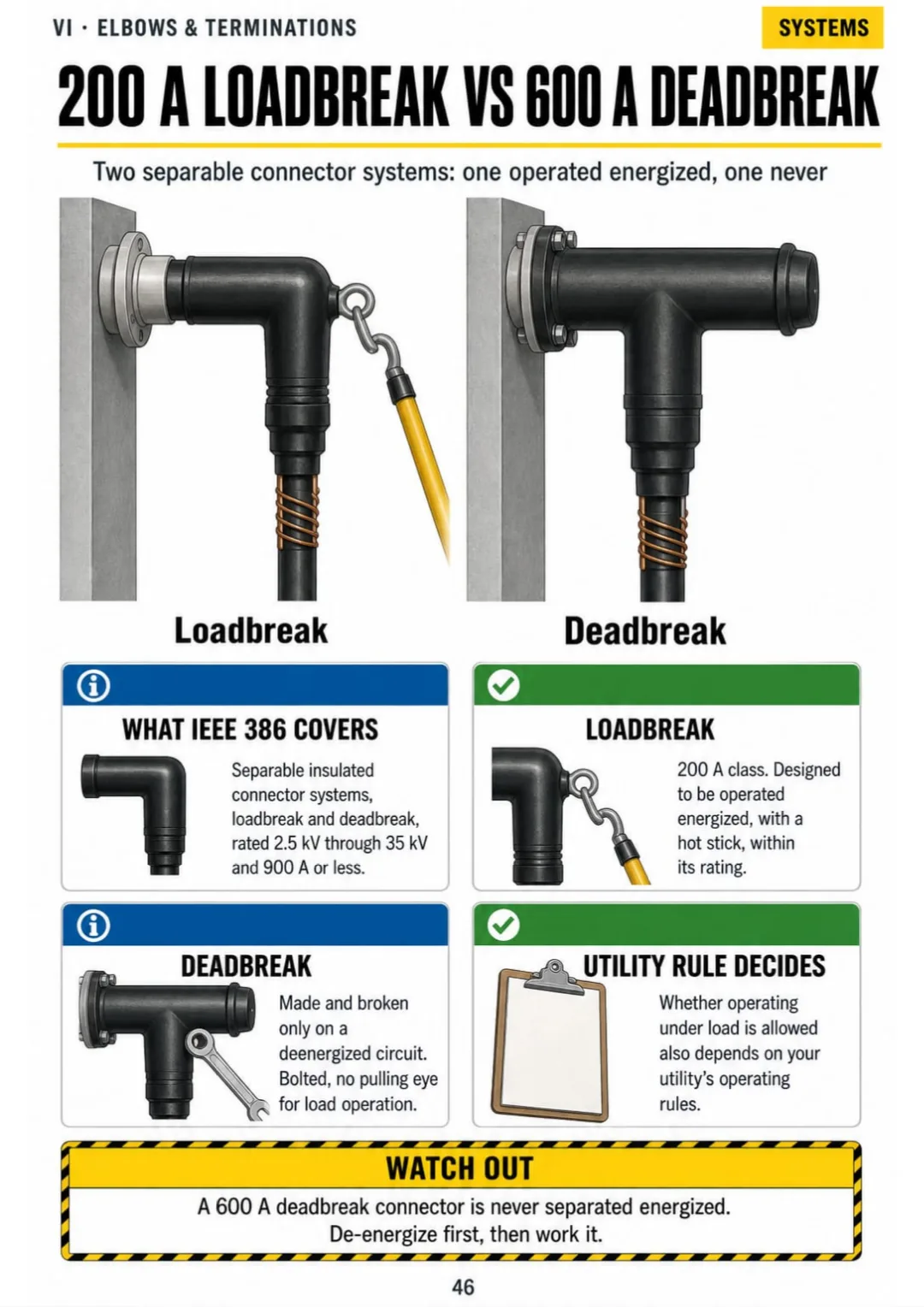
200 A loadbreak vs 600 A deadbreak: which one is operated energized, per IEEE 386
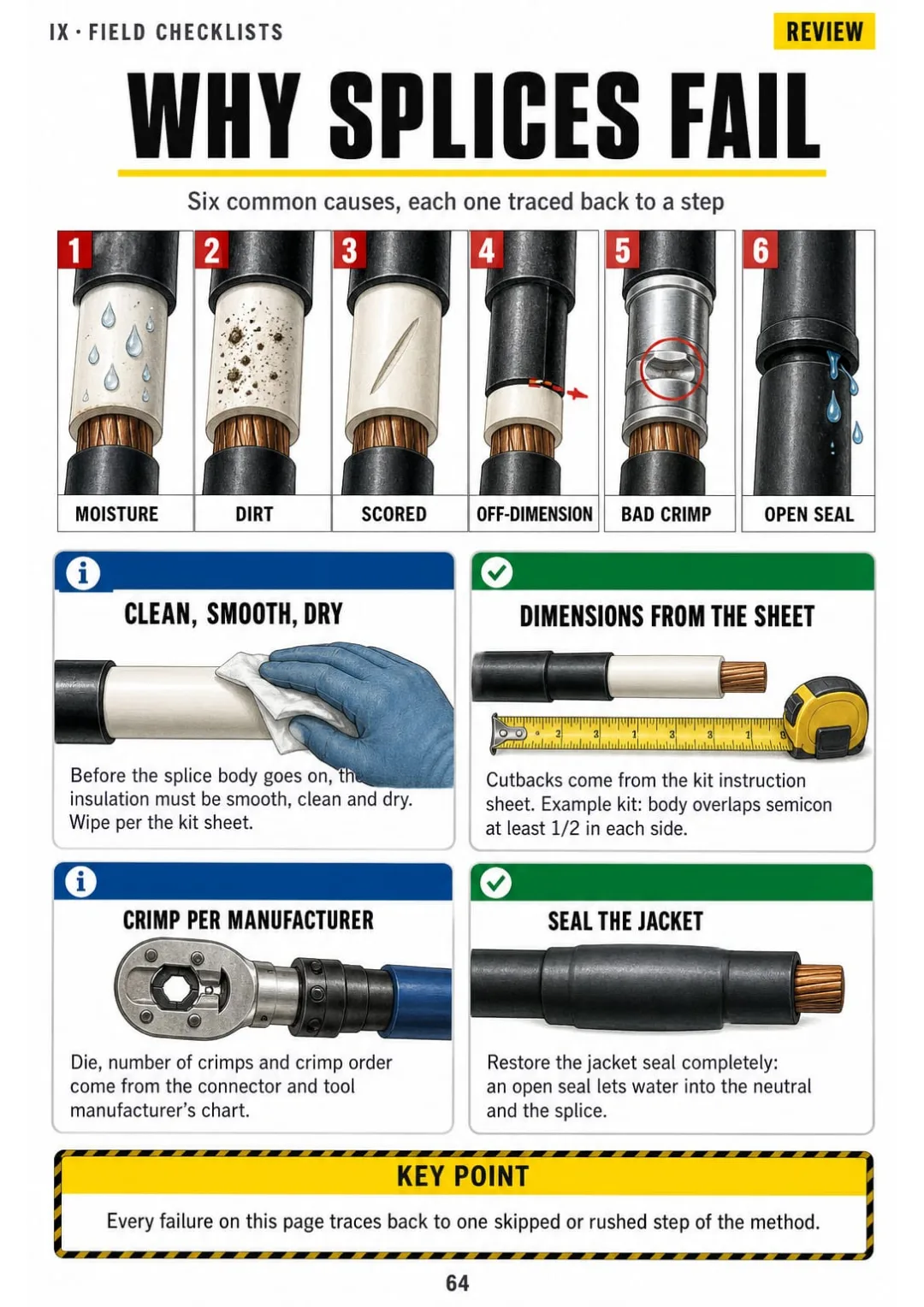
Moisture, dirt, scored insulation, off-dimension cutback, bad crimp, open seal: six causes drawn.
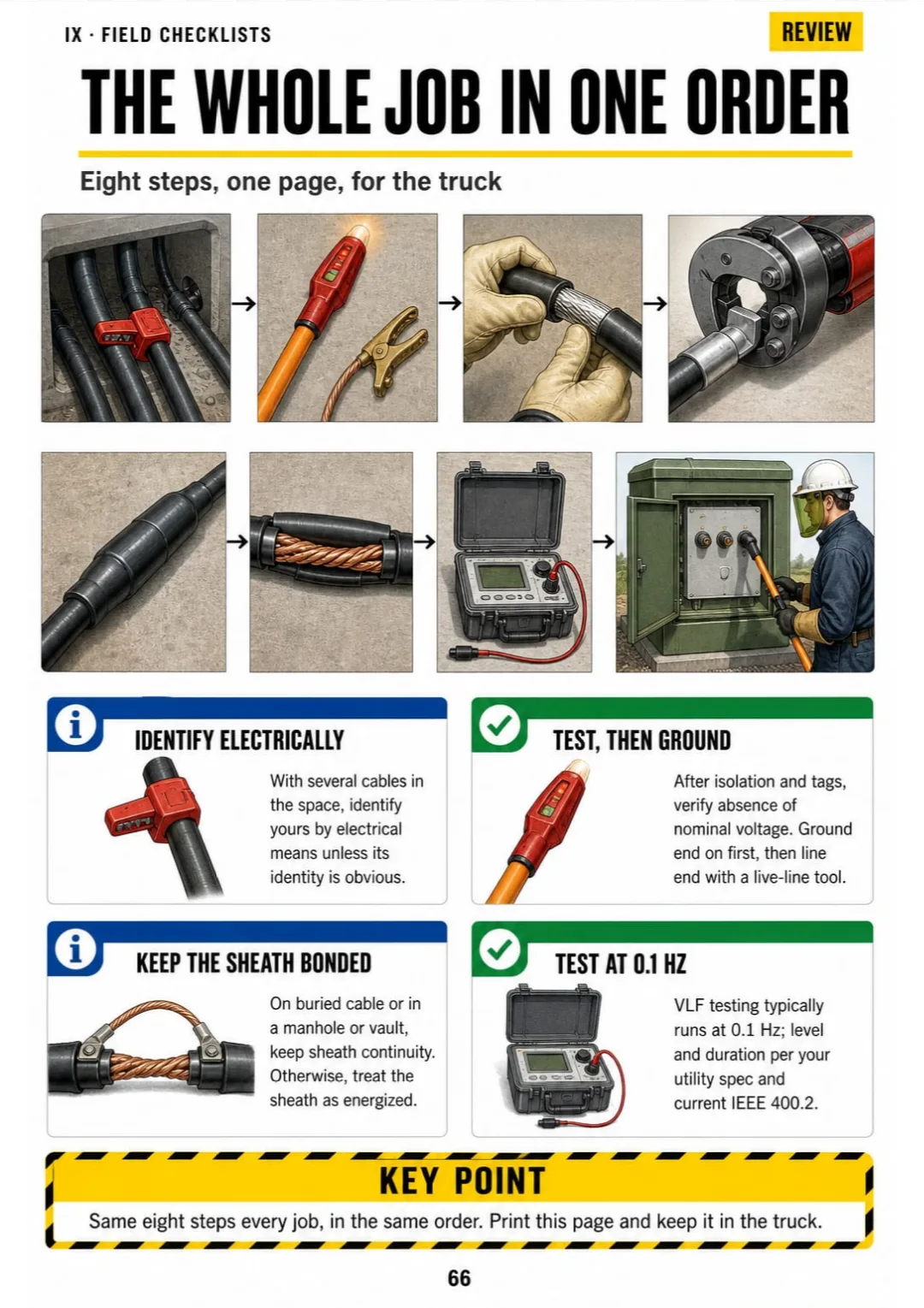
Identify, ground, prepare, crimp, cover, seal, test, energize: one page for the truck.
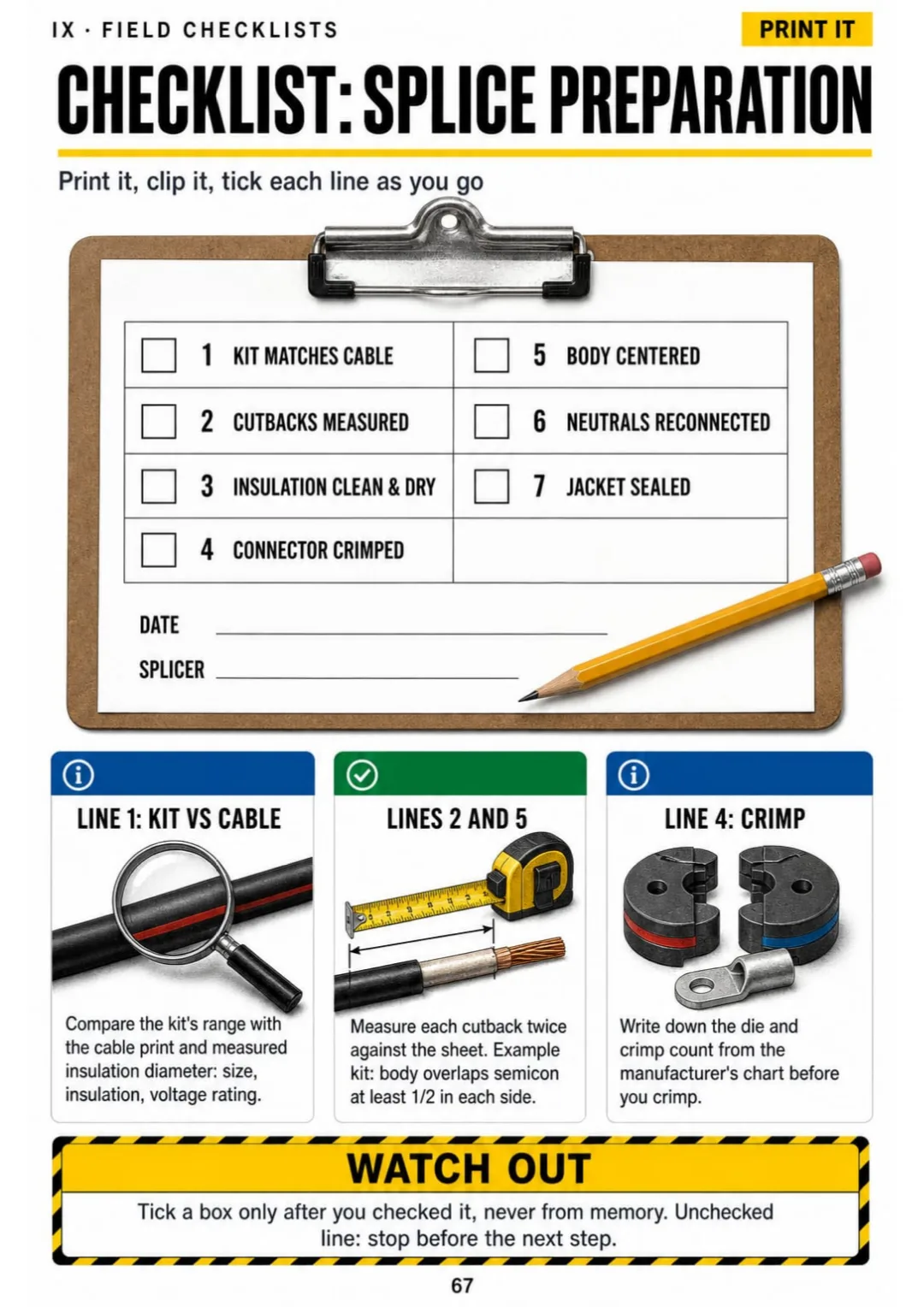
Printable checklist: kit, cutbacks, cleaning, connector, body position, neutrals, jacket.

Swipe to see more →

These are real pages from the book. The table of contents is the full one: 9 parts and 65 topics.

The Problem Isn't You. It's How It Was Explained to You.

You're at the bench with 25 kV cable in your hands and the kit sheet in front of you. Five letters, A to E, and you're not sure which one you measure from.

The manual gives it to you in two paragraphs and a table. Reference point, jacket, neutral, shield cut, insulation: all words, no picture. You read it at night and by morning it's gone.

Overall vs encapsulated jacket: cut the jacket, never the neutral wires.

In the book, that same 25 kV cable is one page: the cable drawn big, dimensions A to E chained from the reference to the jacket, each cut marked where it lands on the cable. Worked out in inches.

Every other topic gets the same treatment: the six cable layers, cold-shrink install, elbow anatomy, why splices fail, the whole job in one order. One topic, one page.

You see why each dimension sits where it does, so the kit sheet finally makes sense when you open it. The numbers still come from your kit sheet and your utility's standard.

COMPARE FOR YOURSELF

The Same Topic, Two Ways to Study It

THIS
  • The manual: line after line after line
  • Approach distances explained only in words
  • You show up to the job second-guessing every cut
Before work begins, the worker determines the voltage of the exposed parts and keeps the required minimum distance from them at all times, allowing for the reach of tools, the length of anything conductive carried into the work area, the chance of an unplanned movement and site conditions such as elevation, while the actual values sit in a separate table that has to be found, matched by voltage range and type of exposure, and then applied to the job in front of you.
FOR THIS
  • Approach distances in one drawing
  • The distances by voltage in a box
  • You see it and you get it
Table R-6, 5.1–15.0 kV: 0.65 m (2.14 ft) phase-to-ground.
CONTENTS

Take a Look at the 9 Parts and 65 Topics

The cable layer by layer, safety before the first cut, the 5-step cut-back method, connectors and crimping, splices, elbows and terminations, padmount and switchgear, testing and energizing, and review with field checklists: 69 pages, all illustrated.

IThe Cable, Layer by Layer · pp. 5-13
  1. Six Layers, One Job Each
  2. The Conductor: Aluminum, Copper, Strand-Filled
  3. The Conductor Shield: Smoothing the Field
  4. Insulation: XLPE, TRXLPE and EPR
  5. The Insulation Shield: Strippable or Bonded
  6. Concentric Neutral, Tape Shield, LC Shield
  7. The Jacket: Encapsulated or Overall
  8. Reading the Cable Print
  9. Electrical Stress at the Shield Edge
IISafety Before the First Cut · pp. 14-21
  1. Qualified and Authorized: What It Means
  2. Identify the Right Cable
  3. De-Energize, Test, Ground: Always This Order
  4. Grounding Elbows and Parking Stands
  5. Minimum Approach Distances
  6. Arc-Rated Clothing and PPE
  7. Manhole and Vault Entry: Test the Air First
  8. Keep It Dry, Keep It Clean
IIIThe Cut-Back Method in 5 Steps · pp. 22-31
  1. The 5 Steps: Identify, Measure, Mark, Cut, Verify
  2. Step 1: Match the Kit to the Cable
  3. Step 2: Measure From the Right Reference
  4. Step 3: Mark Around the Cable
  5. Step 4a: Jacket and Neutral Wires
  6. Step 4b: Removing the Insulation Shield
  7. Step 4c: Insulation and the Bevel
  8. Step 5: Verify Every Dimension
  9. Worked Example in Inches
  10. Cleaning the Insulation: One Direction Only
IVConnectors and Crimping · pp. 32-36
  1. Compression, Shear-Bolt, Bimetallic
  2. Tool, Die and Crimp Count
  3. Crimp Order: Where to Start
  4. Shear-Bolt Connectors Step by Step
  5. Smooth It Before You Cover It
VSplices · pp. 37-45
  1. Inside a Splice
  2. Cold-Shrink: Stretched and Waiting
  3. Cold-Shrink Install: Center Mark and Core
  4. Heat-Shrink: Tubes and Stress Control
  5. Heat-Shrink Technique: Flame and Direction
  6. Premolded Push-On Splices
  7. Reconnecting the Neutrals
  8. Restoring the Jacket and the Water Seal
  9. Transition: Tape Shield to Concentric Neutral
VIElbows and Terminations · pp. 46-53
  1. 200 A Loadbreak, 600 A Deadbreak
  2. Anatomy of an Elbow
  3. Installing a Loadbreak Elbow
  4. Bushing Wells and Inserts
  5. Operating an Elbow With a Hot Stick
  6. Terminations: Indoor and Outdoor
  7. The Riser Pole
  8. Fault Indicators and Test Points
VIIPadmount and Switchgear · pp. 54-58
  1. Single-Phase Padmount, Door Open
  2. Radial Feed vs Loop Feed
  3. Three-Phase Padmount Layout
  4. Padmount Switchgear: Ways and Protection
  5. Elbow Arresters and Phase Marking
VIIITesting and Energizing · pp. 59-63
  1. Insulation Resistance: What the Megger Says
  2. VLF Withstand Testing
  3. Partial Discharge and Tan Delta
  4. Phasing Before You Close
  5. Pre-Energizing Walkthrough
IXReview and Field Checklists · pp. 64-69
  1. Why Splices Fail
  2. Reading Any Kit Instruction Sheet
  3. The Whole Job in One Order
  4. Blank Checklist: Splice Preparation
  5. Blank Checklist: Manhole and Vault Entry
  6. Blank Checklist: Before Energizing

One Page, One Topic, All Clear

Think of it this way:

You're in the vault with a cold-shrink kit open and the foreman waiting on you. You need the install order now, not after a phone call.

You open the cold-shrink page and it's drawn: the center mark, the core pulled out in the right direction, and the semicon overlap checked on each side.

200 A loadbreak vs 600 A deadbreak: which one is operated energized, per IEEE 386

Same with the six cable layers, the 25 kV worked example, elbow anatomy, why splices fail and the whole job start to finish: each one on its own page.

Underground Cable Splicing Illustrated is 9 parts and 65 topics, all drawn, with blank checklists for splice prep, vault entry and energizing at the end.

What you see drawn, you don't have to memorize.

What's Inside Underground Cable Splicing Illustrated:

Ipp. 5-13

The Cable, Layer by Layer

Know what you're cutting before you cut: the six layers and what each one does, conductor types, shields, XLPE, TRXLPE and EPR, jackets, reading the cable print and stress at the shield edge.

IIpp. 14-21

Safety Before the First Cut

Qualified and authorized, identifying the right cable, de-energize, test, ground, grounding elbows, approach distances, arc-rated PPE, testing the air before vault entry and keeping it clean.

IIIpp. 22-31

The Cut-Back Method in 5 Steps

Make every cut-back the same way, on any kit: the 5 steps (identify, measure, mark, cut, verify) through jacket, neutrals, insulation shield and bevel, a worked example in inches and cleaning in one direction.

IVpp. 32-36

Connectors and Crimping

Compression, shear-bolt and bimetallic connectors, tool, die and crimp count, where to start crimping, shear-bolt step by step and smoothing before you cover.

Vpp. 37-45

Splices

Inside a splice, cold-shrink and heat-shrink step by step, push-on splices, reconnecting the neutrals, the jacket and water seal, and tape shield to concentric neutral.

VIpp. 46-53

Elbows and Terminations

200 A loadbreak and 600 A deadbreak, elbow anatomy and install, bushing wells and inserts, hot-stick operation, terminations, the riser pole and fault indicators.

VIIpp. 54-58

Padmount and Switchgear

Single-phase padmount with the door open, radial and loop feed, three-phase layout, switchgear ways and protection, elbow arresters and phase marking.

VIIIpp. 59-63

Testing and Energizing

Insulation resistance, VLF withstand, partial discharge and tan delta, phasing before you close and the pre-energizing walkthrough.

IXpp. 64-69

Review and Field Checklists

Why splices fail, reading any kit sheet, the whole job in order and blank checklists for splice prep, vault entry and energizing.

At the end of the book: A worked cut-back example in inches and blank printable checklists for splice prep, vault entry and pre-energizing.
Plus: 2 Free Books

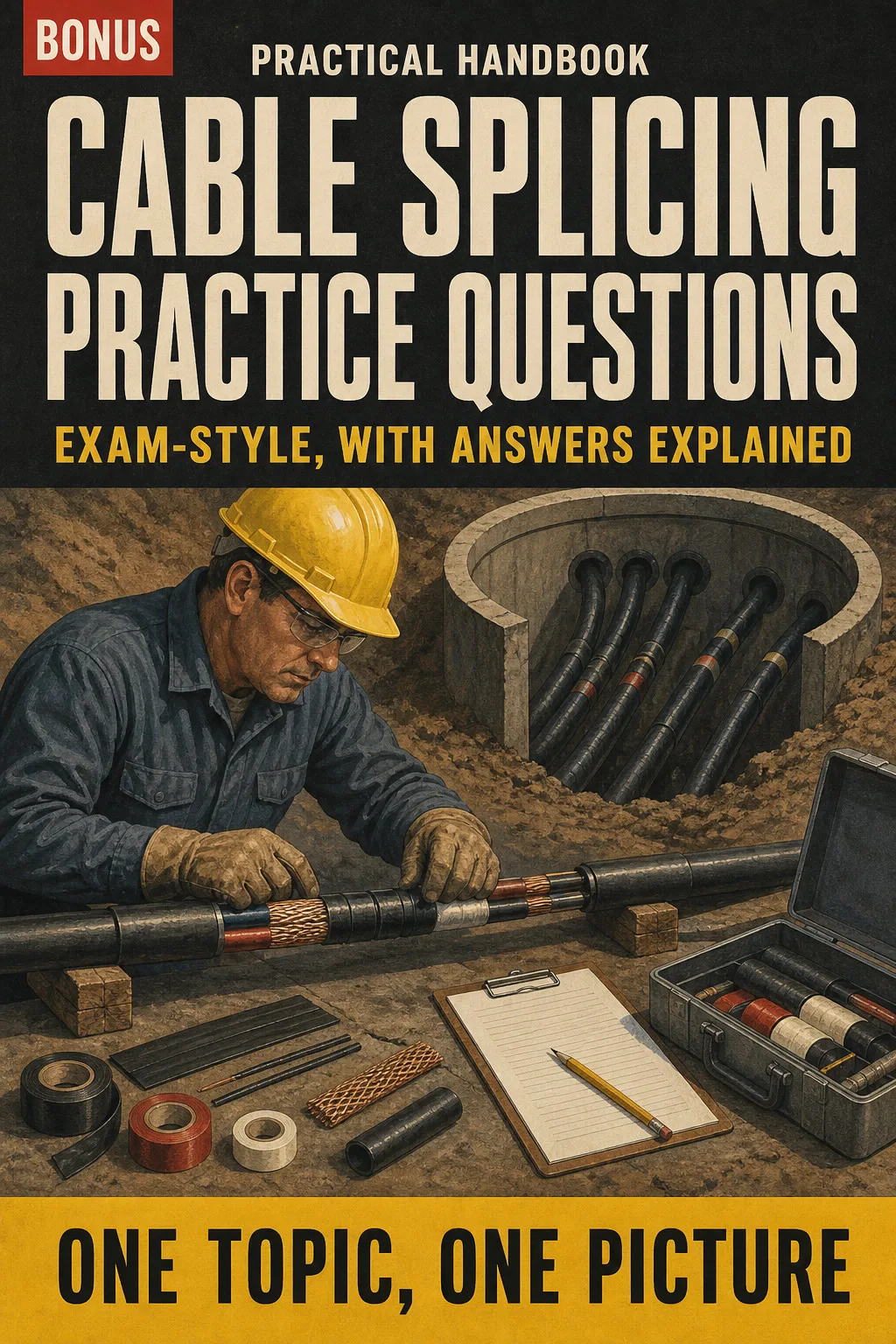
Cable Splicing Practice Questions: Exam-Style, with Answers Explained

BONUS 1: «Cable Splicing Practice Questions: Exam-Style, with Answers Explained»

Value on its own: US$ 17.90

Test yourself on cable layers, cut-backs, splices and testing before your apprenticeship test, and see why each answer is right.

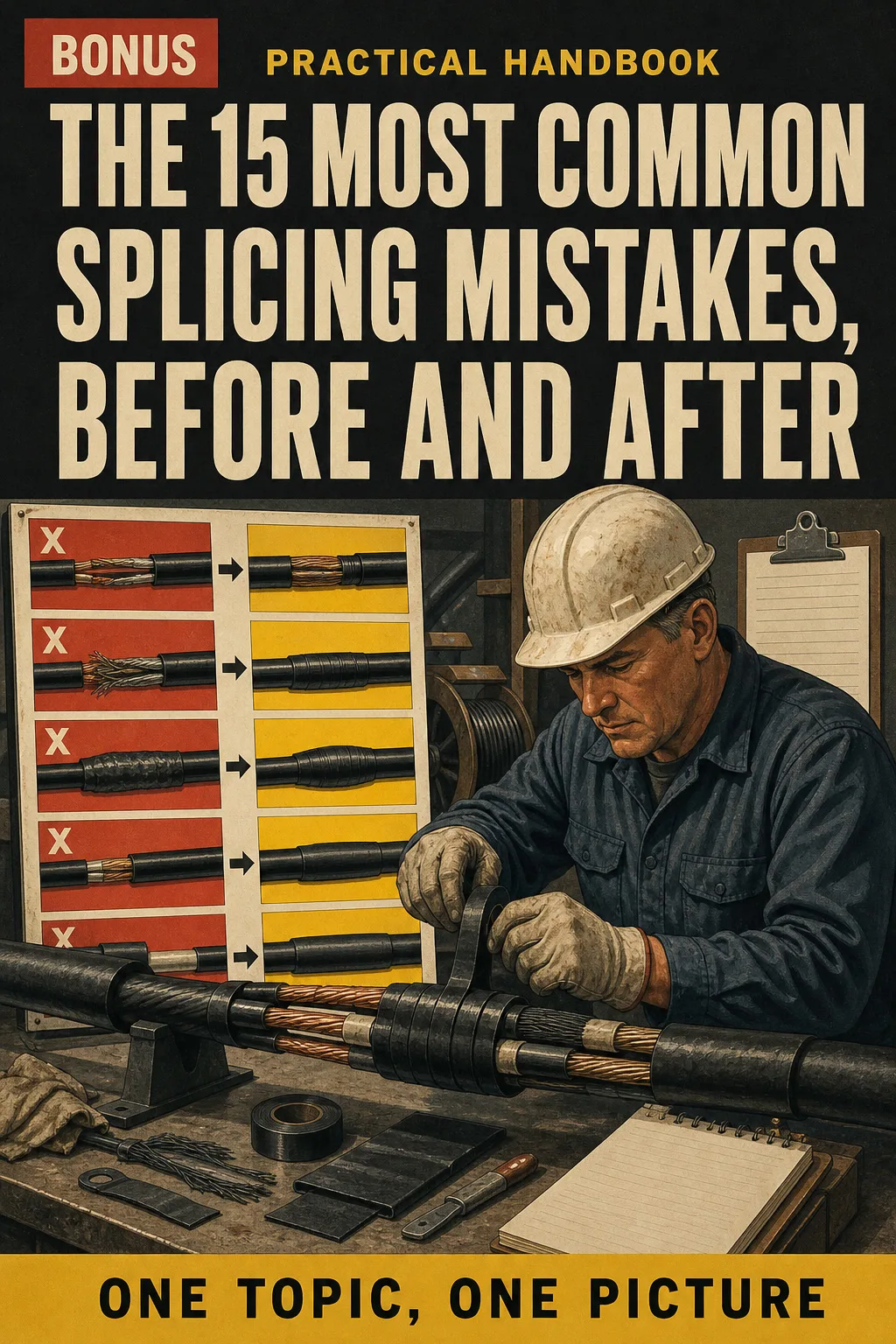
The 15 Most Common Splicing Mistakes, Before and After

BONUS 2: «The 15 Most Common Splicing Mistakes, Before and After»

Value on its own: US$ 14.90

Each frequent mistake drawn next to the correct version, so you spot it on the cable before it becomes a failed splice.

Underground Cable Splicing Illustrated with 2 Free Books

  • Underground Cable Splicing Illustrated: 69 illustrated pagesUS$ 63
  • BONUS 1: Cable Splicing Practice Questions: Exam-Style, with Answers ExplainedUS$ 17.90
  • BONUS 2: The 15 Most Common Splicing Mistakes, Before and AfterUS$ 14.90
  • High-resolution PDF to printIncluded
Total value US$ 95.80
YOUR PRICE:
US$ 27
You save US$ 68.80
YES, I WANT UNDERGROUND CABLE SPLICING ILLUSTRATED FOR US$ 27

📄 This is a digital PDF book sent to your email: nothing is printed or shipped.

Secure purchaseEncrypted payment30-day guarantee

PDF by email: We email you Underground Cable Splicing Illustrated as a PDF, together with the two free books. It's a single payment: no installments, no extra charges.

Who This Book Is For

You're in an apprenticeship program

You're in an apprenticeship program

Every layer, cut and splice drawn in the same order, so what you see on the job finally has a page you can go back to.

Your advancement test is coming up

Your advancement test is coming up

Review the cut-back method, splices, elbows and testing one page at a time, then check yourself with the practice questions.

You already work the line

You already work the line

Going from overhead to URD, or from low to medium voltage: the whole job drawn in one order, printed and kept in the truck.

Everything You Get Today

US$ 95.80US$ 27
YES, I WANT UNDERGROUND CABLE SPLICING ILLUSTRATED FOR US$ 27

📄 This is a digital PDF book sent to your email: nothing is printed or shipped.

30DAYS
GUARANTEE

30-Day Guarantee

Try Underground Cable Splicing Illustrated for 30 days, bonus books included.

We refund everything if the file won't open, if the book isn't what you see here, if you were charged twice or if the email doesn't arrive. Just email us.

You pay once. No subscriptions.

Frequently Asked Questions

Is it for me if I already work as a lineworker or electrician?

Yes. It isn't written for beginners only: it starts with the cable layers and goes all the way to elbows, padmounts and testing, so you can review what you do and see why each step is done that way.

Where does the content come from?

It's built on the US standards for this work: OSHA 29 CFR 1910.269 and 1910.146, the National Electrical Safety Code and IEEE 404, 48, 386 and 400.2. It isn't tied to one manufacturer: it shows what every cold-shrink, heat-shrink or push-on kit asks you to do and why, with a worked example in inches. Your kit sheet and your utility's standard always set the final numbers.

Is this official material?

No. It's an independent study and review guide. It isn't issued or endorsed by any agency, utility, union or manufacturer, and it doesn't give you a certificate or count toward your program hours.

Does it replace my apprenticeship or training program?

No. It's for study and review by qualified, authorized workers and apprentices, and it doesn't replace your program, supervised practice or your kit instructions. What it adds: each step drawn big, with why it's done that way, in the same order every time, so you can go over it at night or in the truck before you do it for real.

Are the practice questions the ones on the test?

No. They're written for this book to help you review, and they aren't official questions from any test.

When and how do I get it?

The book and the 2 bonus books arrive as PDFs by email, at the address you enter at checkout.

Do I have to pay every month?

No. It's a one-time payment.

Can I have it on paper?

Yes. It's a PDF you can print at home or at a print shop and keep in the truck.

How does the refund work?

You have 30 days. We refund everything if the file won't open, if the book isn't what you see on this page, if you were charged twice or if the email doesn't arrive: just email us.

Before You Close This Page

No more rereading the manual with nothing sticking.

The 25 kV cut-back, A to E: you see it drawn, and it clicks.

You show up to the test or the vault knowing where everything is.

Drawings make studying faster.

The book is right below.

One-time payment: US$ 27 · Guarantee: 30 days · PDF by email

YES, I WANT UNDERGROUND CABLE SPLICING ILLUSTRATED FOR US$ 27

📄 This is a digital PDF book sent to your email: nothing is printed or shipped.